Why Everyone is Buying the K70 Pro Tkl (Full Review)
I've been using the K70 Pro Tkl as my daily keyboard for about six months now—switching between long workdays of writing, spreadsheets, and afternoon gaming sessions. When I first saw the buzz around this model, I assumed it was mostly hype. After living with it for a while, what I found was a keyboard that earns most of its hype through tangible, day-to-day improvements and a few predictable trade-offs. This review is a straightforward account of my experience: what I loved, what frustrated me, and whether I think it's worth the attention it's getting.
Introduction: Why I bought the K70 Pro Tkl
I wanted a compact tenkeyless (TKL) keyboard that felt premium, survived heavy typing, and didn't get in the way of my mouse movement during long gaming sessions. I also wanted strong customization options for lighting and macros because I like a tidy desk and a keyboard that can adapt to workflows. The K70 Pro Tkl promised high build quality, solid switches, per-key RGB, and a modern fit-and-finish. After months of real-world use, here's a candid breakdown of that promise versus reality.
First impressions and build quality
Out of the box, the K70 Pro Tkl felt heavy and reassuringly solid. The top plate on my unit is aluminum and has a matte finish that resists fingerprints better than I expected. The keyboard sits firmly on the desk thanks to sizable rubber feet, and the angled profile feels comfortable for long typing sessions without needing an external wrist rest.
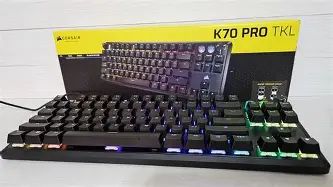
Keycaps on my unit were double-shot or high-quality PBT-like material—smooth but not glossy—so they didn't wear down to a shiny texture after a few weeks. The legends remained crisp after months of daily use. The cable is detachable via USB-C and seems robust; I liked that because it makes transport and replacement simple. There's also a small, subtle logo that doesn't overpower the aesthetic, which I appreciated because I prefer minimalist hardware.
Typing experience and switches
I'm picky about switches, and I swapped through a few profiles before settling on the one I used daily. The K70 Pro Tkl ships with tactile and linear switch options; my sample came with linear switches. What surprised me was how consistent the actuation felt across the board—no mushy keys and no pronounced outliers. The stabilizers were pre-lubed to an acceptable degree (I did add a little more lube to the spacebar and enter for my personal preference), and overall, the keyboard offered a satisfying, smooth keystroke that felt faster and a touch crisper than many other TKL boards I've tried.
For gaming, the low-latency response and short travel distance made fast repeated inputs feel reliable. For typing longer documents, I appreciated the firm bottom-out that gave each keypress a confident stop. One thing I noticed was that the sound signature is slightly higher-pitched than bulkier mechanical keyboards—pleasant to me, but if you like a very deep thock, this might not be it unless you mod it.
Shop the latest Electronics picks on Amazon.
View Offers →Software, customization, and lighting
The keyboard's software gives you granular control over lighting, macros, and profiles. In my experience, the lighting effects are vibrant and look great on a neutral desktop. I created different profiles for work and gaming, and switching between them either via the software or an onboard profile toggle worked without hiccups.
That said, the software is a mixed bag. It offers a lot of features but is occasionally resource-hungry and needed a restart after a Windows update once. I also encountered one quirky bug where a macro I created would not save to the keyboard's onboard memory correctly the first time—I had to recreate it. These problems weren't deal-breakers, but they were annoying enough to mention because they pulled me away from productivity for a few minutes on more than one occasion.
Onboard features and ergonomics
Despite being a TKL, the keyboard keeps a few niceties that I find important: a volume roller, a mute button, and a dedicated function row. The volume roller is satisfying to use—smooth and precise. I rely on it daily during video calls and while producing audio, and it beats hunting for volume sliders in software.
From an ergonomics perspective, the K70 Pro Tkl's height and angle are comfortable for long typing sessions, but I missed having a dedicated wrist rest in the box—something to keep in mind if you prefer a softer landing for your palms. The key spacing and layout are standard, so I had no problems switching from a full-size keyboard.
Durability and long-term use
After six months of daily use, the finish still looks good and the keys show minimal shine. The switches remained consistent, and I didn't experience any spontaneous key dropouts or double-press issues. The detachable cable has held up without fraying. The only component that feels like it might be less durable long-term is the rubber coating on the feet; if you frequently slide the keyboard, they show wear faster than the rest of the build.
What I appreciated most
- Consistent, premium typing feel: keys feel even and responsive across the board.
- Compact but feature-rich layout: TKL size without sacrificing media controls.
- Robust build: heavy, aluminum top plate and solid construction.
- Excellent lighting and onboard customization: vibrant RGB and reliable profile switching.
- Detachable USB-C cable: practical for travel and cable longevity.
What I found disappointing
- Software stability: customization software can be resource-heavy and occasionally glitchy.
- No included wrist rest: I expected a magnetic or soft wrist rest at this price point.
- Higher-pitched sound signature: pleasant but not the deep thock some enthusiasts prefer.
- Rubber feet wear: the feet show faster wear if you reposition the keyboard often.
Pros & Cons
- Pros:
- Solid aluminum build that still feels portable
- Responsive, consistent switches and stabilizers
- Convenient media controls (including a satisfying volume roller)
- Extensive lighting and macro customization
- Detachable USB-C cable and standard TKL layout
- Cons:
- Customization software is sometimes buggy and resource-heavy
- No wrist rest included
- Sound profile may be too bright for some users
- Feet show wear if moved frequently
Comparison: K70 Pro Tkl vs close alternatives
| Feature | K70 Pro Tkl (my unit) | Keychron K8 (wireless TKL) | Ducky One 2 TKL |
|---|---|---|---|
| Layout | Tenkeyless with dedicated media controls | Tenkeyless, wireless-first design | Tenkeyless, compact and classic layout |
| Switch options | Linear/tactile options; responsive and consistent | Hot-swappable options; many switch choices | Variety of mechanical switches; solid stabilizers |
| Software | Feature-rich but occasionally resource-heavy | Minimal software; relies on onboard shortcuts | Little to no software; relies on onboard programming |
| Media controls | Yes — includes volume roller & mute | Basic media keys via function layer | Basic media controls; depends on model |
| Build materials | Aluminum top plate; premium feel | Aluminum frame option on higher SKUs | Plastic shell with solid internal supports |
| Best for | Users who want premium feel + customization | Users who prioritize wireless and hot-swap | Users who want a solid out-of-the-box typing experience |
My day-to-day testing scenarios
To put the K70 Pro Tkl through its paces, I used it for a mix of real tasks: long-form writing, spreadsheet work with complex shortcuts, and competitive FPS gaming. In typing tests (long articles, emails, and notes), I valued the tactile consistency; my speed was stable and I made fewer mistakes than on a softer keyboard. In gaming, the low-latency performance and predictable actuation translated into fewer missed inputs during rapid key sequences.
Shop the latest Electronics picks on Amazon.
View Offers →I also tested lighting profiles across different ambient conditions. The RGB remained bright enough under my desk lamp and still visible in a darker room without being blinding. The onboard lighting profiles meant I could swap from a subtle work profile to an animated gaming profile without opening the software—handy during transitions between tasks.
Buying guide: Is the K70 Pro Tkl right for you?
When I recommend a keyboard, I try to match features to real user needs. Here's how I decide whether the K70 Pro Tkl makes sense for different kinds of users:
Consider this keyboard if...
- You've been using full-size keyboards and want a cleaner desk with more mouse real estate.
- You value a premium build and want a keyboard that looks and feels like a step up from entry-level options.
- You like per-key RGB lighting and want robust customization even if the software isn't perfect.
- You appreciate dedicated media controls and a volume roller for quick adjustments.
- You want a reliable wired connection with a detachable cable for portability.
Maybe skip or rethink if...
- You need wireless connectivity as a core feature—look for wireless-first models instead.
- You expect deep, flawless software integration without occasional hiccups—this keyboard's software works but is not flawless.
- You want a keyboard that arrives with a plush wrist rest—this one does not include one.
- You prefer a very deep, thocky acoustic profile out of the box—this board's sound is brighter.
What to check before buying
- Switch type: Try to test a tactile vs linear variant if possible—switch feel is personal.
- Keycap material: I prefer PBT or double-shot keycaps for long-term durability.
- Onboard memory: Ensure the profile and macro storage meets your needs if you plan to use it across multiple machines.
- Included accessories: Confirm whether a wrist rest or extra keycaps are included if those matter to you.
- Return policy & warranty: Since keyboards are tactile and personal, a good return window makes trial low-risk.
Final thoughts and conclusion
After several months with the K70 Pro Tkl, I feel comfortable saying it lives up to most of the hype. In my experience, the aspects that matter most—typing feel, build quality, and everyday usability—are handled very well. I enjoyed the compact layout without losing media functionality, and the keyboard has held up without hardware issues. The software could be smoother, and I would have liked a wrist rest in the box, but these are quibbles rather than deal-breakers for me.
If you're in the market for a premium TKL that performs well for both work and play and you don't need wireless functionality, the K70 Pro Tkl is one of the stronger options I've tried. I found it to be a reliable daily driver that strikes a good balance between tactile performance, aesthetics, and practical features. For my setup, it has become the keyboard I reach for first—and that's the simplest indicator I can give that it earns the attention it's been getting.